
A batch of training data, a set of model weights, one inference call — how much is each worth, and who should get paid? Traditional AI has never had an enforceable answer.
Introduction: who really owns AI's value
A developer labels ten thousand images to train a vision model. The model ships, gets called by thousands of applications, and starts generating real revenue. What does the developer get? Nothing. Their data was handed over before training even started, and that was the end of the relationship.
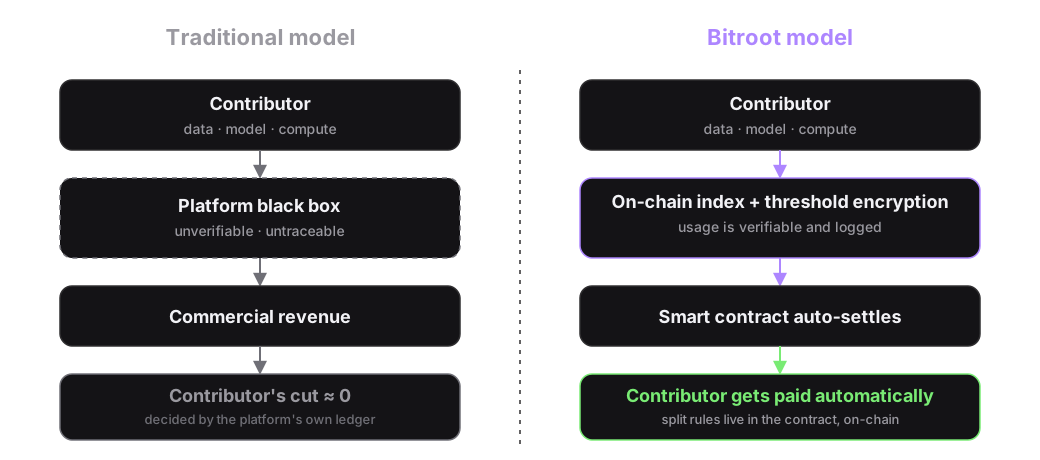
This isn't an edge case. Data gets used, but ownership can't be asserted. Models get called, but revenue never traces back to whoever built them. Compute gets consumed, but the provider takes whatever price the platform sets. None of this is because platforms refuse to share — it's that there's no mechanism to enforce a split in the first place. Who contributed what, and what they're owed, lives in a platform's internal ledger and a paper agreement. Users can't verify it, and they definitely can't make it run automatically.
Part 1: three problems behind the missing ownership
Data never becomes an asset
Hand data to a platform, and control over it is gone. There's no way to prove you supplied it, no way to trace which models it trained, and no way to claim a cut once those models turn a profit. Data becomes raw material — used once, then forgotten — instead of something that keeps paying out.
Models never become assets either
A model's weights are, in a real sense, a digital asset. But almost nothing exists to let that asset be owned, traded, and paid out the way other assets are. Weights typically sit whole on one server; nobody outside it can check who used them, how often, or what that generated. Trainers and designers just accept whatever number the platform hands them.
Revenue-sharing has no enforceable mechanism
Even a platform that wants to pay contributors fairly ends up relying on manual audits and offline deals — slow, expensive, and an easy source of disputes over an opaque split. There's no shared mechanism that pays data providers, model designers, and compute providers automatically, verifiably, and according to rules agreed on up front.
Part 2: what Bitroot actually does about it
None of this is a values problem — it's an engineering one. It needs a concrete mechanism that answers "who contributed what, and how much do they get." Here's what that looks like on each side:
An on-chain index makes data provenance checkable
Bitroot doesn't push massive datasets on-chain. It writes the metadata that matters — file hashes, version numbers, size, diffs between versions — into an on-chain index. The data itself sits on a decentralized storage network, sharded and distributed the way BitTorrent works, with a Merkle-tree check so a node can verify a shard the moment it downloads it. Anyone can confirm a dataset's origin and integrity without the chain ever carrying the data.
Threshold encryption gates access; a TEE keeps the audit trail
Private or commercial data and models need access control. Bitroot splits a decryption key into shares via multi-party computation and threshold encryption — N shares, say, with a majority required to unlock — so no single node can walk off with it. Every access or edit lands on-chain and can't be altered afterward, and a trusted execution environment audits how the data actually gets used in hardware, so a node can't quietly withhold or delete it.
Making model weights usable without making them stealable
This is the hardest part of turning a model into an asset: nodes need to run inference on it without any single one of them ever holding the whole thing. Bitroot shards the weights using a (t, n) threshold scheme — (3, 5), say — splitting them into 5 pieces where any 3 reconstruct enough for inference, and fewer than 3 reveal nothing at all. Each node computes only on its own shard; multi-party computation aggregates the partial results into a final output, and a zero-knowledge proof confirms nothing was tampered with along the way.
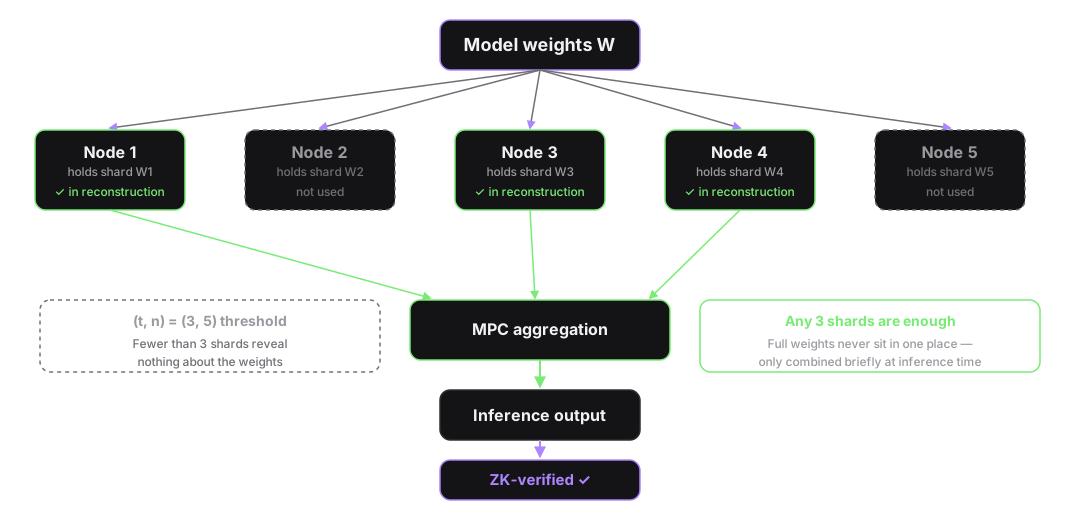
For the first time, a model's right to use it and its right to own it are cleanly separated by the mechanism itself.
Smart contracts run the payout
When a model gets called or turns a profit, the split no longer waits on manual settlement. An on-chain contract executes it against rules set in advance — training-data providers, model designers, and compute providers each have a share written into the contract, and every call triggers a payout that's transparent, verifiable, and doesn't need a trusted middleman. What used to require an offline licensing negotiation is now a piece of code anyone can audit.
Social login lowers the barrier to get in
None of this matters if the barrier to entry is "learn to manage a private key." Bitroot lets people log in with an existing Google account; multi-party computation derives a session key and, from it, an on-chain private key that only ever exists as shards — enough nodes signing at the agreed threshold is what authorizes an on-chain action. From the user's side it looks like logging into any other site. Underneath, it's full cryptographic protection.
Part 3: what happens when you put it all together
Together, these pieces turn "contribute → use → get paid" from something that runs on a platform's books and a user's trust into something that runs on an on-chain index, cryptographic verification, and a contract that executes on its own:
- Data providers can, for the first time, prove what they contributed and get a verifiable claim when that data gets used.
- Model designers can let a model be called widely without worrying its weights will be stolen whole or misused.
- Compute providers get settled against a record anyone can check on-chain, not a ledger a platform keeps to itself.
Data, models, and compute all become things that can be owned, priced, and made to keep paying out — not raw material that stops mattering to whoever contributed it the moment it's used once. That's why Bitroot treats "AI assets" as first-class citizens.
Closing
The AI industry's value-distribution problem was never a shortage of moral consensus — it was a shortage of a mechanism that actually runs. On-chain metadata indexing, threshold encryption and sharded storage, TEE-audited data handling, smart contracts that execute payouts on their own: together, they turn "who contributed what, and how much should they get" from a question a platform decides in good faith into one that's verifiable and enforceable in code. Once data, models, and compute can be owned and traded like any other asset, the rules for how AI's value actually gets split have a real chance to change.